
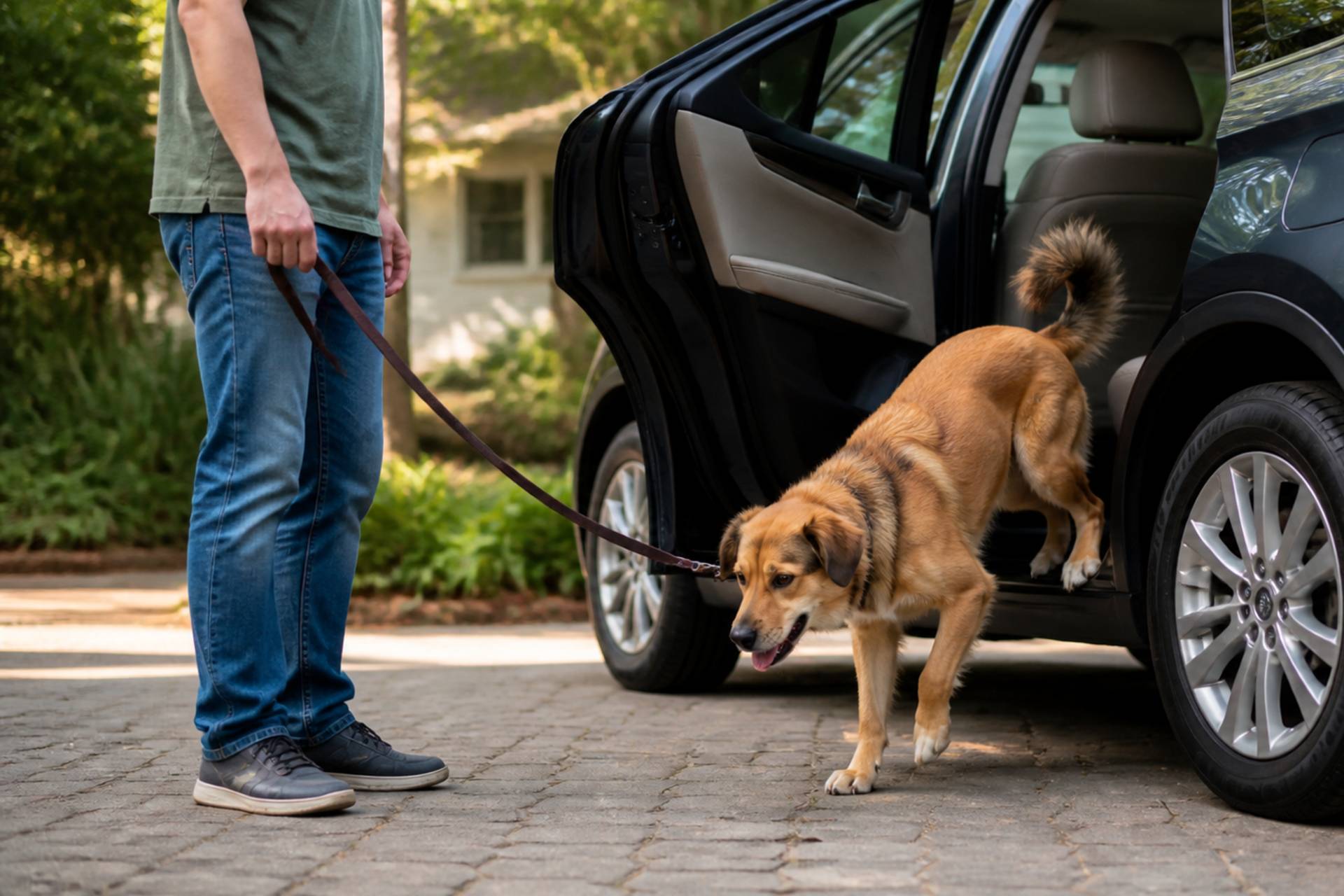

The reunion at pickup can look completely normal. Your dog pulls toward you, performs a full-body tail wag, inspects every corner of the car, and acts as though you have been gone for six months instead of four days.
Then you get home.
After a nap, the trip from the dog bed to the water bowl looks slower. The first few steps are careful. Maybe the jump onto the couch comes with a pause that was not there before the stay.
That change does not tell you exactly what happened, and it is not a diagnosis. It does tell you to pay attention. Boarding can temporarily change nearly every part of a dog’s normal movement day: how much they play, where they rest, which surfaces they cross, and how often they settle. When they return to a familiar home, those differences can be easier to see.
A boarding stay is a different movement day
Even a well-run boarding facility cannot reproduce your dog’s home routine exactly. A quiet dog may spend more time standing and watching. A social dog may play harder or longer than usual. Rest may happen on a different bed or floor. Potty walks, doorways, turns, and transitions may all follow a new pattern.
None of those details proves that boarding caused an injury. They simply give useful context if your dog comes home moving differently.
The reverse can be true, too: boarding does not automatically mean a setback. One Synchrony client recently reported that her dog, who was already making steady progress while dealing with a cruciate ligament injury, returned from boarding doing well. His condition had not been noticeably aggravated, and his progress continued after he came home. That single experience cannot predict how another dog will respond, but it is a useful reminder to compare the dog in front of you with their own baseline instead of assuming the stay caused a problem.
For Florida dogs, August can add another layer. Outdoor activity may happen in shorter windows around heat and afternoon storms. Indoor floors may be smoother than the grass, rugs, or familiar routes your dog uses at home. A dog who is excited at pickup may also look more comfortable in that moment than after the excitement fades and a long nap begins.
The useful question is not, “Was boarding bad for my dog?”
It is, “What is different from my dog’s normal?”
Watch the ordinary transitions
You do not need to stage a test or push your dog through exercise. Watch the movements that already happen during the first day or two home:
-
rising after a nap;
-
walking across tile, rugs, and grass;
-
turning toward the food or water bowl;
-
stepping over a threshold;
-
using familiar stairs;
-
getting into the car or onto a favorite resting place;
-
settling down and changing positions.
Look for a repeatable change, not one awkward step. Is the same hind leg consistently unloaded? Does your dog shorten the same part of the stride? Is a familiar turn suddenly wide or careful? Does the hesitation return after each period of rest?
Your baseline matters here. Nobody knows your dog’s ordinary routine better than the person who sees it every day.
If possible, record a short video on a safe, non-slip surface. Cornell’s College of Veterinary Medicine notes that home videos can be valuable because some dogs move differently at a clinic due to excitement or adrenaline. A simple note about when the change appears—after rest, on stairs, during turns, or throughout the day—can also help your veterinarian evaluate the pattern.
Tired is not the same as painful
Some dogs sleep deeply after boarding because the environment and routine were different. Sleep alone does not tell you that a dog is sore. The more useful clues are changes in mobility, activity, behavior, and daily habits.
Cornell lists stiffness or limping, difficulty rising, slower walking, reluctance to exercise, changes in posture, reactions to touch, restlessness, and trouble getting comfortable among signs that can accompany pain. Those signs can have many causes. That is why observation should lead to the right evaluation—not a home diagnosis.
Call your veterinarian if your dog is limping or having trouble walking. Seek prompt veterinary direction for an inability to bear weight, marked weakness, poor coordination, severe or worsening pain, known trauma, or other sudden concerning changes. Do not give human pain medicine unless your veterinarian specifically directs it.
Give the first day home less pressure
If your dog is comfortable walking and your veterinarian has not given different instructions, the first day home does not need to become a make-up day for missed adventures.
Keep the routine simple:
-
offer water and the normal feeding routine;
-
provide a familiar, comfortable resting place;
-
use calm leash walks for bathroom breaks instead of hard play;
-
reduce slippery-floor sprints where practical;
-
avoid forcing stairs, jumps, stretches, or long exercise to “work it out”;
-
watch whether movement becomes easier, stays the same, or worsens.
The goal is not to treat an unknown problem at home. It is to let your dog settle while you gather a clearer picture.
It can also help to ask the boarding facility a few neutral questions. How much group play did your dog have? Were there any slips, falls, scuffles, appetite changes, or unusual periods of rest? Did staff notice limping or reluctance with a particular movement? Good information is more useful than blame.
Where chiropractic may fit
Once urgent injury and veterinary concerns have been addressed, a movement-focused evaluation may be worth discussing for a dog who remains stiff, guarded, or different from baseline. Chiropractic does not replace a veterinary examination, imaging, medication, or rehabilitation when those are needed.
Its role is to assess how the body is moving as a whole: spinal and extremity motion, symmetry, posture, and the ways one area may be carrying extra work. Any care plan should be individualized. There is no responsible way to promise that every post-boarding change has the same cause or needs the same number of visits.
Because Synchrony is mobile, an evaluation can happen in the dog’s familiar environment across Gainesville, Ocala, The Villages, and the communities in between. That can make it easier to discuss the exact bed, doorway, floor, stair, or car movement where the owner first noticed the change.
Your dog’s normal is useful information
A happy pickup does not cancel out what you notice later at home. It also does not mean every slow step is an emergency.
Stay with what you can see. Record the pattern. Contact your veterinarian when limping, walking difficulty, or other concerning signs are present. Then, if veterinary needs are covered and your dog still is not moving like themselves, a whole-body movement evaluation may be worth considering.
If your dog returned from boarding stiff, guarded, or slower than usual, Synchrony Chiropractic can talk with you about whether a mobile chiropractic evaluation fits the next step alongside appropriate veterinary care.