
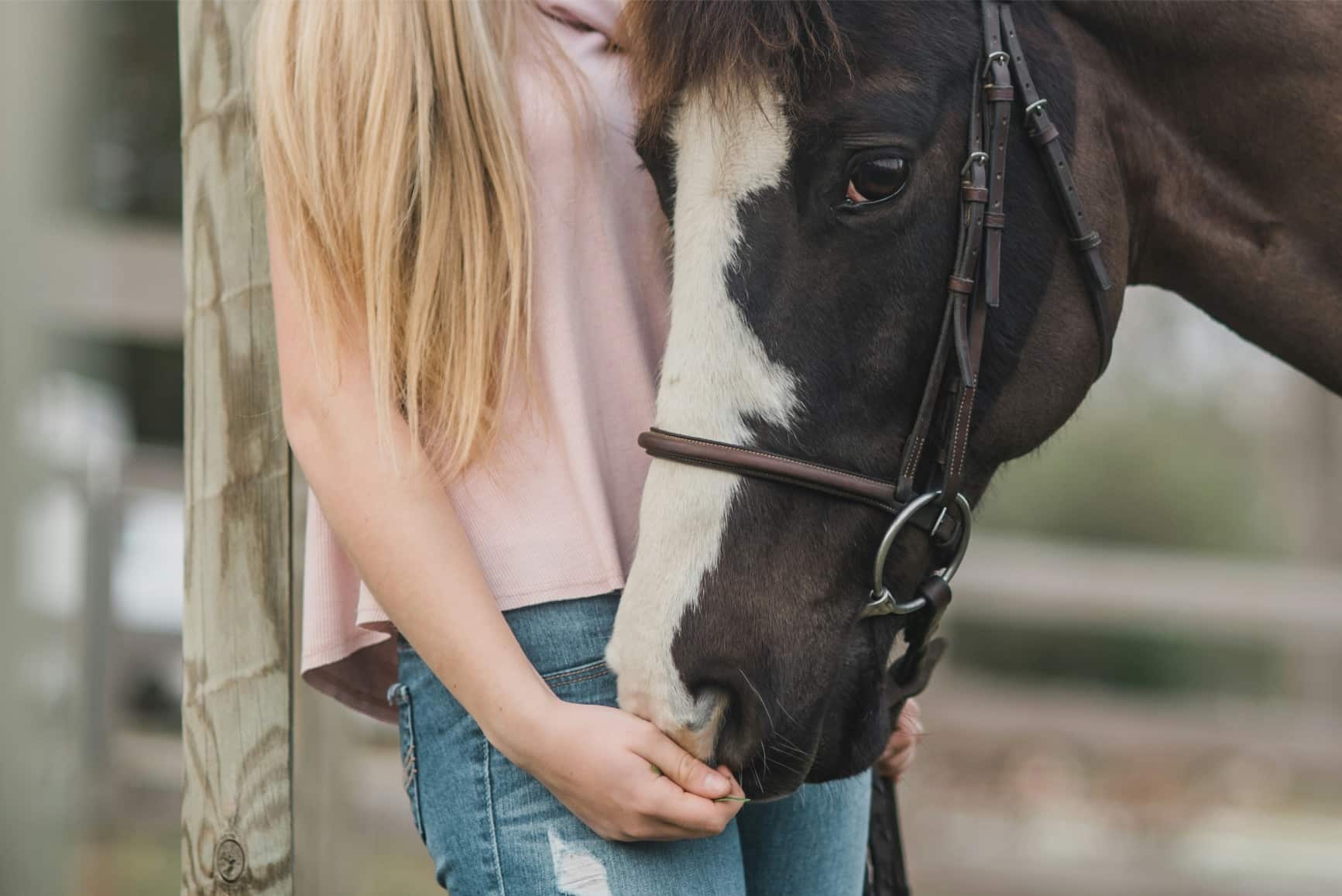

You know your horse. You’ve ridden him enough times to know what he feels like when he’s right, and you’ve been around him enough to know when something’s shifted. It’s not dramatic. He’s not lame, he’s not refusing, he’s not doing anything that would make a stranger look twice. But something is different, and you can feel it even if you can’t quite name it.
Maybe he’s a little flat in his transitions. Maybe the left lead feels like more of a negotiation than it used to. Maybe he pinned his ears when you tightened the girth this morning and you told yourself it was just a mood. Maybe he’s been a little dull, a little resistant, a little less like himself, and you’ve been giving it another week for the past month and a half.
That feeling you have? It’s worth listening to. Horses communicate constantly, and most of what they’re saying never gets heard because we’re not always sure what we’re listening for. This blog is about changing that.
The Language Horses Speak
Here’s something that shapes everything about how horses communicate discomfort: they’re prey animals, and prey animals are hardwired to hide vulnerability. In the wild, a horse who shows obvious pain or weakness becomes a target. That instinct doesn’t disappear just because your horse lives in a safe barn with a good grain ration and people who love him. It’s in his DNA, and it means he’s going to mask discomfort far longer and far more effectively than most owners realize.
This is why the gap between “he’s fine” and “he’s really not fine” can be almost invisible until it suddenly isn’t. A horse dealing with significant spinal restriction might look completely normal to a casual observer. He’s eating, he’s moving around the pasture, he’s doing his job. What he’s also doing is compensating, adapting, and working around the problem in ways that are subtle enough to miss if you don’t know what you’re looking for.
The signs horses give us aren’t usually loud. They’re not a dramatic refusal or an obvious lameness. They’re a slight change in character, a behavioral shift that came on gradually, a performance issue that doesn’t quite make sense given the training. Learning to hear those quieter signals is one of the most valuable things a horse owner can develop, because the earlier you catch what the horse is telling you, the easier it is to help him.
The Difference Between a Bad Day and a Sign Worth Acting On
Every horse has bad days. Every horse has a ride that feels off for no identifiable reason, a morning where the girth makes him grumpy, a session where the right lead just isn’t happening. One instance of almost anything is not a sign. A pattern is a sign.
What you’re watching for is a change in frequency, consistency, or character from your horse’s established baseline. The horse who occasionally pins his ears at the girth is different from the horse who has started doing it every single time for the past three weeks. The horse who had a flat ride last Tuesday is different from the horse whose impulsion has been progressively declining since the end of show season. The horse who was mildly resistant on the left rein once is different from the horse who has been consistently stiffer going left for two months.
The “I’ll give it another week” cycle is real, and it’s one of the most expensive habits in horse ownership. Not financially, though that too eventually, but in terms of what happens inside the horse’s body while you’re waiting. Compensation patterns get deeper. Muscle imbalances get more established. What started as a joint restriction that would have been relatively straightforward to address becomes a whole-body pattern that takes significantly longer to unwind. The horse who was giving you a subtle sign in January is the horse who’s giving you an obvious sign in April, and the difference between addressing it in January versus April is meaningful.
The Signs Your Horse Needs a Chiropractor: Under Saddle
These are the signs that show up in your work together, and they’re the ones most likely to get labeled as training issues before anyone considers a body issue. Some of them are training issues. But when they appear suddenly, persist despite good riding and good training, or are associated with other changes on this list, they’re worth investigating from a physical standpoint.
- Resistance or reluctance picking up a specific lead. This is one of the most common things we hear about. When a horse who used to pick up both leads reliably starts having a consistent issue with one side, the body deserves a look before the training does.
- Difficulty bending or maintaining bend through turns. Asymmetrical bend is often a sign of cervical or thoracic restriction. The horse who falls out through one shoulder or can’t quite maintain the arc through a corner on one rein is frequently telling you something about what’s happening in his spine.
- Loss of impulsion or a flatness that wasn’t there before. When a forward, willing horse starts feeling like he’s moving through mud without a clear environmental reason, it’s worth asking what changed in his body.
- Hollowing through the back instead of lifting and swinging. A horse who’s protecting his back is going to hollow away from pressure rather than lift into it. This often gets addressed through riding, but if the riding isn’t fixing it, the body might be why.
- Shortened stride on one side. Watch your horse move at liberty or on a longe line and look at whether his hind legs are tracking up evenly. Consistent asymmetry in stride length is a meaningful signal.
- Pinning ears or tail swishing during specific movements. Horses use their face and tail to communicate discomfort, and when those expressions are tied to specific movements or requests rather than general attitude, they’re telling you something specific hurts.
- Resistance to contact or reluctance to collect. A horse who’s developed a new aversion to the bridle or who resists collection that he previously accepted willingly often has restriction in the poll, cervical spine, or thoracic region that makes those positions uncomfortable.
- Behavioral changes that feel like attitude but started recently. This one is important. When a willing horse becomes resistant, a generous horse becomes difficult, or an easy horse becomes complicated, and it happened gradually over weeks or months, the first question should be whether his body is comfortable, not whether his training needs an overhaul.
The Signs Your Horse Needs a Chiropractor: On the Ground
The signs that show up outside of riding are often the ones that get missed the longest, partly because people aren’t always watching as carefully on the ground and partly because they’re easier to rationalize as personality quirks.
- Sensitivity or resistance during grooming along the back and hindquarters. A horse who flinches, moves away, pins his ears, or swishes his tail when you curry or brush along his back and topline is telling you that area is uncomfortable. This is not a grooming preference. It’s a pain response.
- Asymmetry in how the horse stands at rest. Watch your horse when he’s just standing in the cross ties or in his stall. Is his weight distributed evenly? Does he consistently rest one hind leg more than the other? Does his topline look symmetrical from behind? Consistent asymmetry in rest posture is often a sign of restriction or discomfort.
- Resistance or sensitivity during bridling. A horse who has started throwing his head up, pulling away, or showing tension when the bridle goes on may have poll or cervical restriction that makes that position uncomfortable.
- Reluctance to pick up a specific foot. When picking up one foot consistently causes more resistance or difficulty than the others, it can reflect restriction in the hip, pelvis, or lower back on that side that makes shifting weight uncomfortable.
- Changes in how the horse moves at liberty. A horse who’s moving freely in the pasture without a rider gives you unfiltered information about how his body actually feels. If he’s short-striding, moving stiffly, or not moving the way he used to when he’s just being a horse, that matters.
- Postural changes at rest that are new. A horse who has started standing with his hind legs camped out, who holds his neck differently than he used to, or whose topline shape has changed without a corresponding change in fitness or condition is showing you something worth investigating.
The Signs Most People Miss Entirely
These are the ones that don’t make the typical “does my horse need a chiropractor” list, but we see them regularly and they’re worth knowing about.
Personality and behavioral shifts are probably the most underappreciated sign on this entire list. The horse who was friendly at the gate and has become standoffish, the horse who loved being groomed and now tolerates it, the horse who was always eager to work and has become dull and checked out. These changes happen gradually enough that owners adapt to them without realizing the baseline has shifted, and they almost never get connected to physical discomfort until someone points out the connection.
Changes in herd dynamics can also reflect physical discomfort. A horse who’s dropped in herd hierarchy, who’s getting pushed around more than he used to, or who’s isolating himself more may be doing so because his body isn’t letting him hold his position the way it normally would.
Asymmetrical muscle development over time is something you can see if you’re looking for it. A horse who’s been compensating for a restriction on one side will often develop noticeably different muscle mass between the two sides of his topline, hindquarters, or neck. That asymmetry is the body’s physical record of how long the compensation has been happening.
Changes in trailering behavior catch people off guard as a chiropractic sign, but a horse who has become more difficult to load, who scrambles more than he used to, or who arrives at destinations more stressed and braced than before may be experiencing discomfort during the trailer ride that’s connected to spinal restriction.
Why These Signs Point to Chiropractic Specifically
All of these signs have something in common: they reflect changes in how the nervous system is coordinating the horse’s body. When a joint in the spine loses its normal range of motion, the nervous system response is immediate. Muscles guard the area, signals reroute around the restriction, and the body starts compensating to protect what’s compromised.
This is why these signs often don’t show up on standard veterinary workups. Imaging looks for structural damage: fractures, arthritic changes, soft tissue injuries. It doesn’t capture functional restriction, which is a joint that looks structurally normal but has lost its normal range of motion and is affecting nervous system communication as a result. A horse can have a completely clean set of X-rays and still have significant spinal restriction that’s driving every sign on this list.
That’s not a failure of veterinary medicine. It’s just a different tool measuring different things, and chiropractic assessment fills a gap that imaging genuinely cannot.
What Happens If You Wait
We’re not trying to create urgency for its own sake here, but we do want to be honest about what happens in a horse’s body when the early signs get ignored long enough.
Compensation is cumulative. A horse compensating for a lumbar restriction starts loading his shoulders more heavily. The shoulders develop tension from the increased load. The neck starts bracing to manage the tension in the shoulders. The poll tightens in response to the neck. What started as one restricted joint has become a whole-body pattern, and unwinding that pattern takes considerably more time and more sessions than addressing the original restriction would have. Early intervention is almost always simpler, faster, and more effective than late intervention, and the horse is more comfortable sooner. That part matters too.
Insider Tips from Dr. Philip and Dr. Angela
On the sign owners almost always dismiss:
The single most common thing we hear when we arrive at a barn is some version of “I almost didn’t call because I wasn’t sure it was bad enough.” And almost every time, we find something meaningful. Your instinct that something is off is almost always correct. The threshold for calling doesn’t need to be obvious lameness or dramatic behavior. If something has changed and it hasn’t gone back to normal on its own within a reasonable window, that’s enough reason to have someone take a look.
On doing a basic at-home observation before you call:
Before you reach out, spend ten minutes watching your horse move on a flat surface without a rider. Watch from behind, from the front, and from the side. Video it if you can because you’ll catch things on playback that you miss in real time. Note whether the hind feet are tracking symmetrically, whether the stride length looks even on both sides, and whether there’s any hitch or asymmetry in the hips. Then watch him stand at rest and note his posture. That information makes the first conversation significantly more useful.
On what to write down before you call:
Note when you first noticed something, what specifically changed, whether it’s consistent or intermittent, what activities seem to make it more obvious, and whether anything else has changed around the same time (new saddle fit, change in workload, recent hauling, any falls or stumbles). The more specific you can be, the faster we can zero in on what’s happening.
When to Call Us vs. When to Call Your Vet First
We want to be clear about this because it matters: chiropractic care and veterinary care work together, and there are situations where the vet is absolutely the first call.
Call your vet first if your horse is acutely lame, if there’s visible swelling or heat in a joint or limb, if he’s showing signs of significant pain like not wanting to move or being unable to bear weight, if something audible happened (a pop, a crack, a stumble with a fall), or if the change came on suddenly and dramatically rather than gradually.
Chiropractic is a strong starting point when the signs are gradual and behavioral rather than acute, when your vet has done a workup and everything looks clean but something still isn’t right, when the issue is performance-based rather than lameness-based, or when the pattern fits what you’ve read here and your gut is telling you it’s a body issue rather than a training issue.
When in doubt, call us anyway. We’ll tell you honestly if what you’re describing sounds like something your vet should see first, and we work alongside veterinary teams regularly. The goal is always the best outcome for your horse, and sometimes that means pointing you in a different direction before we ever schedule an appointment.
Your Gut Is Usually Right
Horse people develop a feel for their horses that’s genuinely hard to explain to someone who doesn’t have it. You know when something’s changed. You know when the ride doesn’t feel like your horse. You know when the expression in his eye is a little different than it usually is, even if you can’t quite articulate why.
That knowing is worth trusting. It’s worth making a call about, worth having someone come take a look, worth not dismissing for another week while you wait to see if it resolves on its own.
Your horse is telling you something. He’s been telling you something, probably for a little while now. We’d love to help you figure out what it is and do something about it together.
Reach out to Synchrony Chiropractic and let’s take a look. We serve horses throughout Gainesville, Ocala, the Villages, and surrounding areas, and we’re always happy to start with a conversation.