
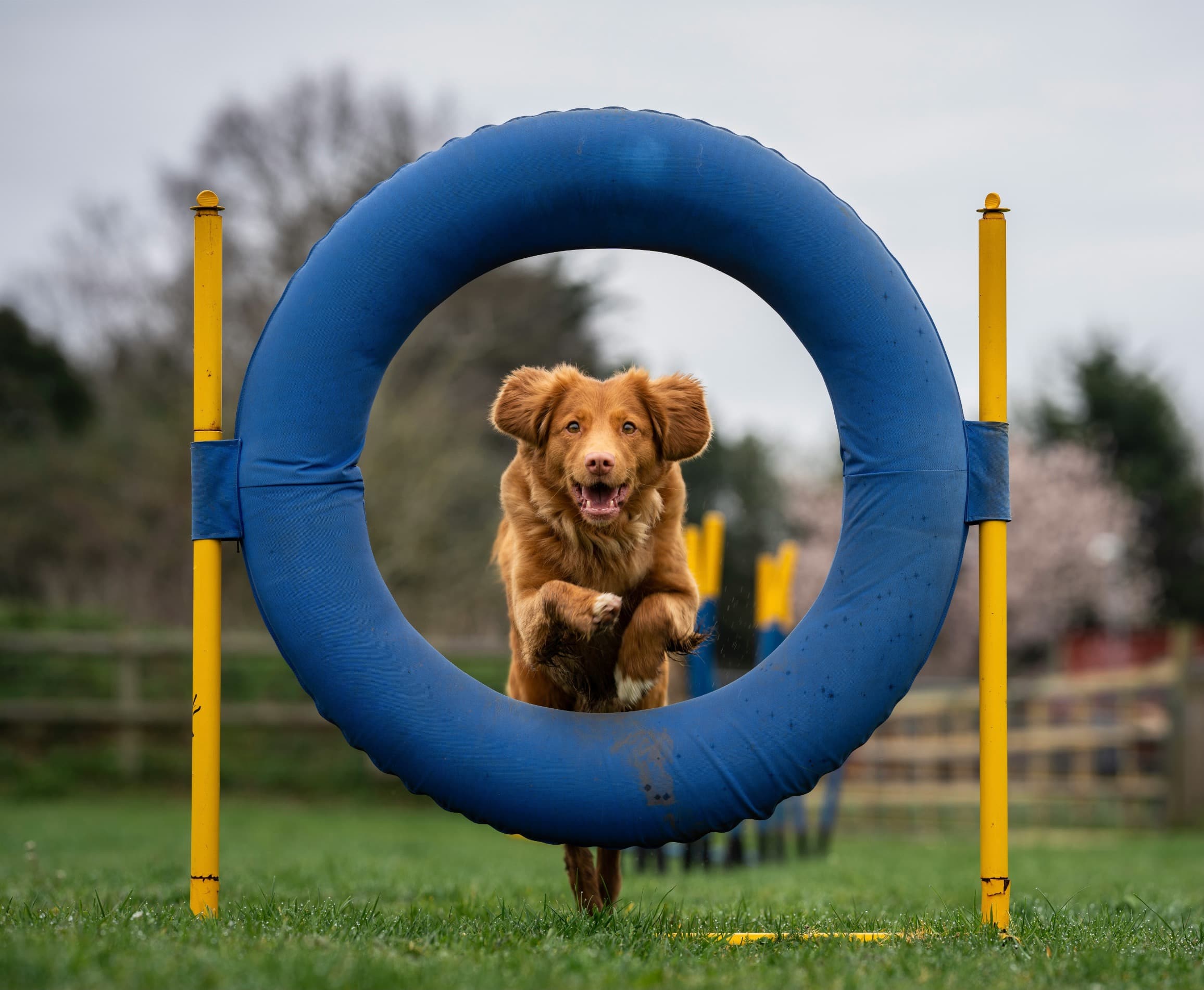

You know the type of dog we’re talking about.
The one who would run every trail, fetch every ball, and do every agility course back to back to back if you let him. The one who has never once in his life voluntarily stopped a game of fetch, whose tail is already going before you even touch the leash, and who looks at you every single morning like today might finally be the day you agree to just go forever. He’d do this forever if his body let him, and most of the time his enthusiasm makes it easy to believe that it will.
Then one day, coming out of a tunnel or landing off a jump or finishing a long trail run, something happens. A yelp, a limp, a sudden reluctance to do the thing he was just doing ten seconds ago with complete joy. You call the vet, you do the rest, you do the rehabilitation, and somewhere in the middle of all of it you think: how did I not see this coming? Here’s the honest answer: you probably could have. Not because you were being careless, but because the warning signs that precede most dog injuries are subtle, easy to normalize, and almost nobody tells you what to look for until after the fact.
That’s what this guide is for.
Why Dog Injuries Rarely Come Out of Nowhere
The “out of nowhere” injury is one of the most common things we hear from athletic dog owners, and we completely understand why it feels that way. One moment the dog is fine, the next he isn’t. There was no obvious incident, no dramatic fall, no collision, just a dog who was going hard one minute and limping the next. But the body doesn’t usually fail without warning. It gives warnings. We just often don’t speak the language.
What looks like a sudden injury is almost always the endpoint of a process that’s been building for weeks or months. A restriction develops when a joint in the spine or an extremity loses its normal range of motion from repetitive stress, an old minor incident, or compensation from something else in the body. The nervous system adapts by rerouting signals around the restriction while muscles tighten to guard the area, and the body keeps moving but not as efficiently as before. Compensation patterns form as other parts of the body start absorbing load that the restricted area isn’t handling well, and the muscle, tendon, ligament, or joint that’s been compensating for the original restriction eventually takes on more than it can handle. To the owner it looks like it came from nowhere. To the body, it was the inevitable result of a long chain of events.
Understanding this process changes how you think about prevention entirely. You’re not trying to prevent a random event. You’re trying to identify and address the early links in the chain before they reach the end, and that’s a much more manageable problem than it sounds.
The Athletic Dog’s Specific Risk Profile
Not all dogs carry the same injury risk, and athletic dogs have a specific set of vulnerabilities that are worth understanding honestly. The first one is probably the most important: fit is not the same as structurally sound.
A dog can be lean, muscular, and cardiovascularly excellent while simultaneously carrying spinal restrictions, compensation patterns, and overloaded joints that nobody has addressed. Fitness doesn’t protect against dysfunction, and in some cases a very fit dog will actually push harder through dysfunction than a less fit dog would, which accelerates the timeline to injury rather than slowing it down. Repetitive movement patterns also create specific wear patterns, so the agility dog who runs the same course hundreds of times is loading the same joints the same way over and over, the fetch dog whose ball always lands to his right is making that right-side hind approach thousands of times, and the trail dog who always takes the same loop is navigating the same rocks and roots repeatedly. Repetition is how athletic dogs get good at what they do, and it’s also how specific areas of their body take disproportionate wear.
The Florida environment adds to the load in ways that are easy to underestimate. Year-round activity without a natural off-season means Florida’s athletic dogs are accumulating stress without the seasonal reset that naturally provides some recovery, and adding heat, humidity, and varied outdoor surfaces means a dog whose body is managing more on a daily basis than most people account for.
The Warning Signs That Precede Most Injuries
Here’s the list we wish every athletic dog owner had memorized, because these are the signs that show up in the body before an injury makes the problem undeniable.
Physical signs to watch for:
- Subtle asymmetry in gait that’s easy to miss unless you’re specifically watching for it on a slow, deliberate walk
- A shortened stride on one side that shows up most clearly when the dog is moving slowly rather than at full speed
- Reluctance to fully extend or flex a specific limb during normal movement
- Muscle asymmetry when you run your hands along both sides of the spine and hindquarters
- Flinching or tension when you apply gentle pressure along the spine or at the sacroiliac area
- Stiffness after rest that warms out quickly and gets dismissed as just a slow morning
Behavioral and performance signs:
- Dropping bars on a specific side in agility that wasn’t happening before
- Hesitation before launching off a jump or out of a tunnel that used to be automatic
- Slower times or reduced drive in a dog who’s normally a hundred percent effort every time
- Unusual post-exercise fatigue that seems disproportionate to the actual work done
- Increased sensitivity to touch along the back or hindquarters that wasn’t there before
- Subtle changes in how the dog holds or carries his tail
The one owners miss most often is a dog who’s “a little quieter” after hard work and seems to take longer to bounce back than he used to. This gets attributed to age, to a hard session, to the heat, and sometimes that’s accurate. But when it’s consistent, it’s the body communicating that the workload and the recovery are no longer in balance, and that’s worth paying attention to before the next hard session adds more to what’s already building.
What Proactive Injury Prevention Actually Looks Like
Prevention sounds passive, but it isn’t. Proactive injury prevention is an active practice built around regular assessment, honest observation, and addressing what the body is showing before it becomes something that takes weeks or months to recover from. Here’s what that looks like in practice.
Regular Chiropractic Assessment
This is the foundation, and it’s worth being clear about what it actually is: a chiropractic assessment for an athletic dog isn’t a crisis intervention. It’s a systematic evaluation of how the spine and nervous system are functioning, where restriction is developing, and what compensation patterns are beginning to form. Finding a restriction early means a straightforward adjustment and a few days of lighter work. Finding that same restriction six months later, after it’s become deeply established and generated significant compensation throughout the body, means a much longer and more involved recovery process. The difference in outcome between those two scenarios is significant, and we’ve watched it play out enough times that we feel pretty strongly about the value of not waiting.
For actively competing or working dogs, we recommend:
- A baseline assessment at the start of each season or competitive year
- Regular check-ins every four to six weeks during active periods
- An assessment after any unusual incident, hard fall, or collision, even if the dog seems fine
- An end-of-season evaluation before any downtime begins so you know what you’re carrying into the off-season
Soft Tissue Work
Muscles tell a real story, and a dog whose muscles feel symmetrical, supple, and well-hydrated is a dog whose body is recovering well. A dog with tight, ropy, or asymmetrical muscle development is a dog who’s compensating somewhere, and regular soft tissue work keeps the muscular system supple while reducing the likelihood that a tight muscle becomes the weak link that fails under load.
Smart Training Structure
Prevention is also a training conversation, and the principles here aren’t complicated but they do require consistency:
| Principle | What It Looks Like in Practice |
| Warm up before every session | 5-10 minutes of easy movement before asking for full effort |
| Cool down after every session | Gradual reduction in intensity rather than a hard stop |
| Vary surfaces and movement patterns | Reduces the wear that comes from pure repetition |
| Build in genuine rest days | Not light work days, actual rest where the dog isn’t being asked to perform |
| Cross-train | Variety in movement builds broader structural resilience |
| Match workload to recovery | If recovery is taking longer than usual, reduce load before adding more |
Know Your Dog’s Baseline
This is the most underrated prevention tool available, and it costs nothing. Know what your dog looks and moves like when he’s completely fine, watch him walk across the yard, notice how he rises from a nap, pay attention to how he carries his tail and how evenly his hind feet track behind his front feet. When you know the baseline intimately, small deviations become obvious, and small deviations caught early are what prevention is actually made of. The owners who catch things earliest aren’t the ones with the most training. They’re the ones who pay attention.
The Prevention Investment vs. The Injury Cost
We hear from owners regularly that they want to be more proactive but feel like adding regular chiropractic check-ins to the budget is hard to justify when the dog seems fine. We understand that completely, and we also want to offer a different frame for thinking about it.
The average soft tissue injury in an athletic dog involves veterinary diagnostics, weeks to months of restricted activity, rehabilitation costs, and the emotional weight of watching a dog you love be unable to do what he loves. A season of proactive chiropractic care costs significantly less than one significant injury, measured in every currency that matters: money, time, and the quality of life your dog doesn’t get to have while he’s recovering from something that might have been preventable. We’re not trying to scare anyone into scheduling an appointment. We just think it’s worth doing the math honestly.
For the Dog Who Would Go Forever If You Let Him
Your athletic dog’s enthusiasm isn’t a problem to manage. It’s one of the best things about him, and that joy, that drive, that complete commitment to the game is genuinely worth protecting. The goal of injury prevention isn’t to slow him down or wrap him in bubble wrap. It’s to make sure his body can keep up with everything he wants to give you, which means regular assessment, honest observation, smart training structure, and a team that helps you stay ahead of what’s building in his body before it becomes something that takes him off the field.
He would run every trail and fetch every ball forever if his body let him. Let’s help make sure it can. Reach out to Synchrony Chiropractic for a proactive assessment on your athletic dog, because the best injury is always the one that never happens.