
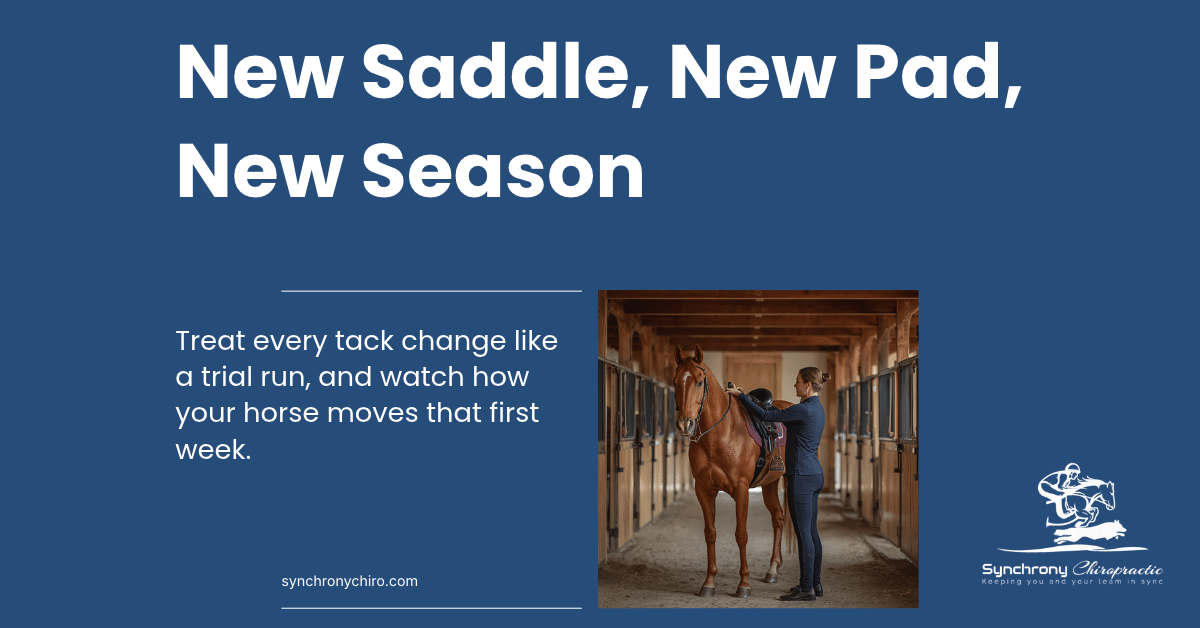

The new saddle came out of the box smelling like leather and good intentions. You set it on your horse, stepped back, and admired it.
November is when a lot of Central Florida riders refit or replace tack. The winter circuit is coming, and a summer of lighter work may have changed your horse’s shape.
New tack is exciting. Here’s the thing. Your horse gets a vote too.
Why a tack change deserves a trial run
A saddle, pad, or girth sits on your horse for every minute of every ride. Even a small change in where it presses can change how your horse feels about the work.
Extension guidance on saddle fit compares a well-fitting saddle to a comfortable boot. When it doesn’t fit, a horse may show displeasure under saddle, or simply not bend and collect as well.
Your horse isn’t being difficult with the new saddle. He may be telling you how it feels.
Before the first ride
Start on the ground. Set the saddle on with the pad you plan to use, and do up the girth the way you normally would.
With a rider up, there should be clear space between the gullet and the withers. If you’re not sure what you’re looking at, that’s a good moment to bring in your saddle fitter.
It also helps to change one thing at a time when you can. Change the saddle, pad, and girth all in one week, and it’s hard to tell what your horse is reacting to.
Week one: what to watch
Think of the first week as a quiet experiment. Keep rides familiar so the tack is the main thing that’s new.
Notice how your horse:
- Stands for tacking and girthing
- Stands at the mounting block
- Moves off in the first few strides
- Bends and turns in each direction
- Picks up and holds the canter leads
Compare what you see with your horse’s normal from the last few months. One off day can be just an off day. A pattern is worth attention.
Read the sweat after the ride
Your horse’s back can tell you a lot once the saddle comes off. Extension guidance suggests riding until your horse sweats under the pad, then looking at how evenly that sweat is spread.
Dry spots, especially on either side of the withers, can mean pressure is concentrated in one area. Dry spots with raised skin are a bigger concern.
Run your hand along the back too. Notice any flinching, sinking, or new sensitivity, and where it shows up.
More padding isn’t always the answer
When something seems off, it’s tempting to add another pad. Sometimes that helps. Sometimes it makes a tight saddle tighter.
Extension guidance notes that more padding isn’t always better, and that some pads trap heat or concentrate pressure instead of spreading it. A pad can support a good fit. It can’t make up for a saddle that doesn’t fit your horse.
Signs worth taking seriously
Back discomfort in horses can come and go, which makes it easy to miss. University extension guidance lists signs such as sourness with saddling or riding, stiffness on tight turns, and reluctance to change leads.
The same guidance includes a few more:
- Restricted movement
- Cold-backed behavior
- Refusing to work
- Head tossing
- Less push from behind than usual
If you see these, stop and look more closely before you push through. Talk with your saddle fitter about fit, and with your veterinarian if your horse seems sore or the change doesn’t settle.
Don’t forget the rider
Saddle fit is about both of you. A saddle that puts you out of balance can change how your weight lands on your horse’s back.
If a new saddle feels different for you, mention it to your trainer. Rider balance is one of the things extension guidance lists when a horse’s back is uncomfortable.
Where we fit
A tack change is a good time to check in on the whole horse. Your saddle fitter looks at the saddle. Your veterinarian looks at health concerns. Chiropractic care can be one part of keeping your horse comfortable through his back and body as the season ramps up.
We come to your barn, so your horse stays in his own routine. All we need is cross-ties or a hand on the lead.
If your horse has felt different since the tack changed, we’d be glad to take a look. Text us at 352-356-8665 to book.