
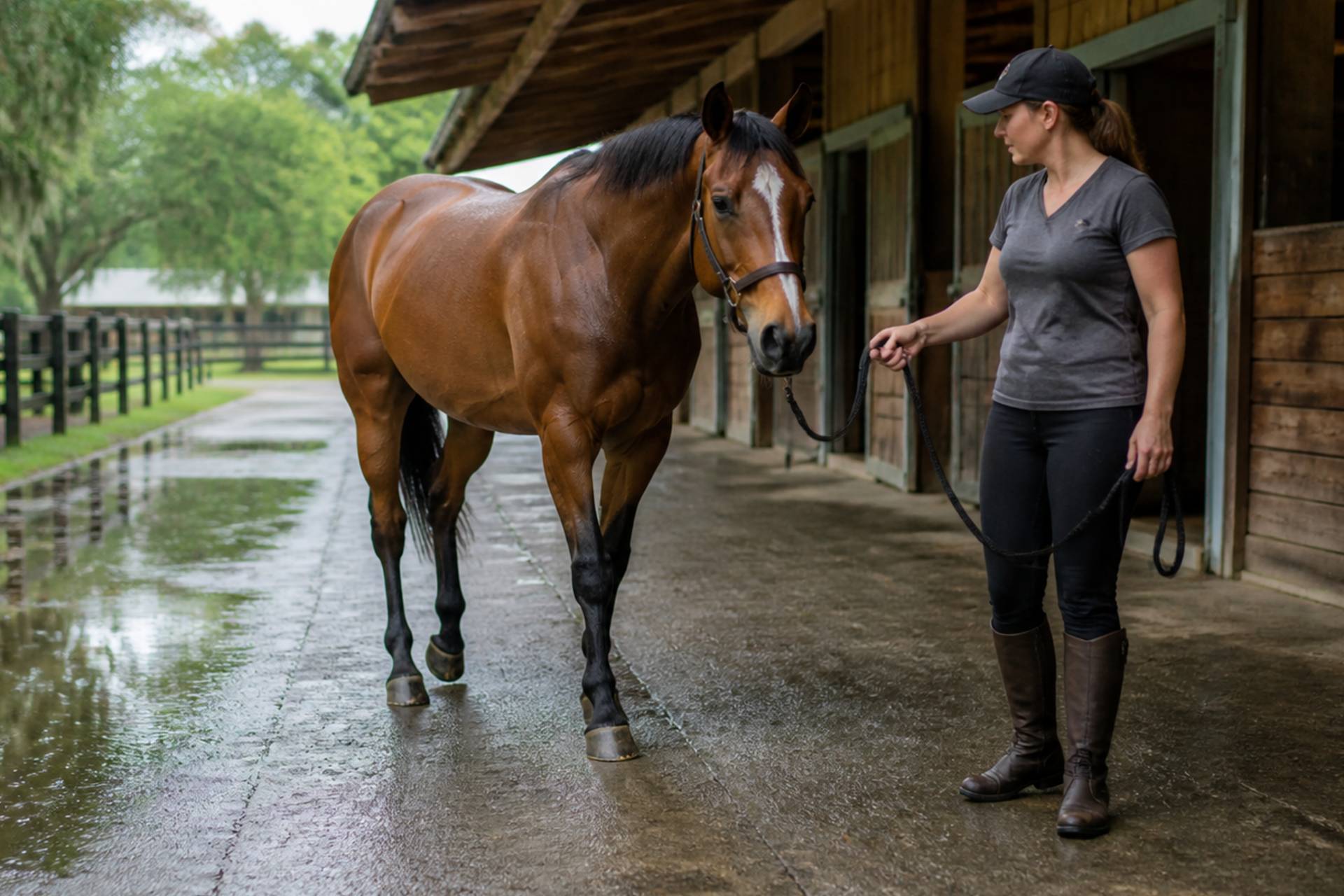

The afternoon storm has passed. The aisle is damp, the wash rack is still holding a thin sheet of water, and your horse walks through it without falling.
Technically, nothing happened.
But you felt the lead rope tighten. His head came up. One hind foot landed a little wide, and the next few steps looked shorter and more careful than the ones before them.
That small moment is easy to dismiss, especially in a Central Florida barn where wet concrete, muddy entrances, and sudden downpours are part of August. Yet a horse does not need to hit the ground dramatically for slick footing to change the way he uses his body. A slide, scramble, or near-slip can trigger bracing—and that protective pattern may follow him out of the wash rack.
A near-slip is still a whole-body event
A horse moving across uncertain footing has a fast job to do. He must place four feet, manage a high center of mass, and keep a large body balanced while the surface underneath him offers less grip than expected.
When a hoof slides, even briefly, the rest of the body reacts. The neck may lift. The back may stiffen. The horse may widen his stance or shorten the next step. Muscles can tighten quickly to keep the slip from becoming a fall.
That response is useful in the moment. It is the body protecting itself.
The question is whether the horse returns to his normal movement once he reaches reliable footing. Some shake it off and walk away normally. Others continue to guard, especially if the surface has been slick more than once or the scramble asked a tired body to recover quickly.
You may notice:
-
shorter, more deliberate steps through the aisle;
-
hesitation before stepping onto the wash-rack surface;
-
a wider hind stance or careful pivot;
-
raising the head and hollowing the back during a turn;
-
reluctance to back up where the floor is wet;
-
stiffness when walking out after bathing;
-
a new difference in one direction when circling, tacking up, or beginning work.
These observations do not diagnose an injury. They do tell you that the horse changed his strategy.
The surface matters before the horse ever slips
Good barn footing is not simply a housekeeping preference. It affects whether a horse can stand, turn, lie down, rise, and walk with confidence. Penn State Extension lists dryness, traction, levelness, and some give among the important qualities of horse-facility flooring. It also notes that some materials become slick when wet and that drainage strongly affects how a floor performs.
In Florida, the trouble is often a combination rather than one obvious defect:
-
wind-driven rain reaches an otherwise covered aisle;
-
water collects where a slab has settled;
-
algae develops along a shaded edge;
-
soap or conditioner remains in a wash area;
-
sand, manure, or grass clippings create a loose layer over concrete;
-
a mat shifts, curls, or traps water beneath it;
-
horses repeatedly pivot at the same doorway and polish the surface smooth.
A floor that feels acceptable in dry boots may behave very differently under a wet hoof, especially during a tight turn.
Watch the transitions between surfaces too. A horse may move confidently on textured concrete, then shorten abruptly where that surface meets mud, a loose mat, pavers, or a storm-soaked turnaround. Those borders often reveal more than the middle of the aisle.
Look at the next ten steps
If your horse has an awkward moment but remains standing, resist the urge to test him immediately with a tight circle or brisk trot. Lead him quietly onto secure footing and watch the next several steps.
Compare what you see with his normal movement:
-
Is he bearing weight evenly?
-
Does one limb take a shorter step?
-
Can he turn both directions without scrambling or swinging wide?
-
Is there new swelling, heat, bleeding, or an abnormal limb position?
-
Does his expression settle, or does he remain anxious, sweaty, or guarded?
Severe lameness, refusal to bear weight, an abnormal limb angle, marked swelling, bleeding, or signs of shock call for immediate veterinary guidance. The American College of Veterinary Surgeons advises keeping a horse quiet and contacting a veterinarian immediately when fracture is suspected. Do not force movement or attempt a splint unless your veterinarian directs you.
For a smaller near-slip without emergency signs, keep monitoring. Notice how the horse walks later that day and the next time he leaves the stall. Pay attention during grooming, picking up feet, backing, and the first easy minutes of work. If the change persists, worsens, or simply does not look like your horse, involve your veterinarian.
Fix the footing, then address the movement
It is tempting to focus only on the horse after a slip. The environment deserves the same attention.
Practical barn checks include:
-
remove standing water, soap residue, algae, manure, and loose debris;
-
check whether drains are clear and whether water actually reaches them;
-
inspect mats for movement, curled edges, gaps, and trapped moisture;
-
add a secure, purpose-designed traction solution rather than a loose temporary layer;
-
improve lighting so puddles and surface changes are visible;
-
avoid asking a horse to make a tight pivot on the slickest part of the floor;
-
close off an unsafe route until it can be corrected.
Then consider what the horse’s body is telling you. If he keeps bracing, stepping short, resisting a direction, or moving differently after the incident, a veterinary evaluation may be warranted. Once urgent injury and other medical causes are addressed, a chiropractic evaluation may be worth considering as part of a broader care plan to assess joint motion, compensation, and how comfortably the horse is using his body.
Chiropractic care does not make unsafe footing safe, and it does not replace veterinary diagnosis after trauma. The useful work is collaborative: correct the environment, rule out injury, and evaluate movement that does not return to normal.
Small moments deserve a second look
Most wet-barn incidents are not dramatic. That is exactly why they disappear from our attention so quickly.
The horse stayed up. Chores continued. The aisle dried.
But if his steps changed, even quietly, take another look. Owners, riders, and barn managers know the difference between a horse being cautious for three strides and a horse who carries that caution into the rest of his day.
If your horse has cleared veterinary concerns but still seems guarded, uneven, or uncomfortable after a slip or scramble, contact Synchrony Chiropractic to ask whether a mobile equine chiropractic evaluation may be a useful part of his support plan. We serve horses across Gainesville, Ocala, The Villages, and the communities in between.