
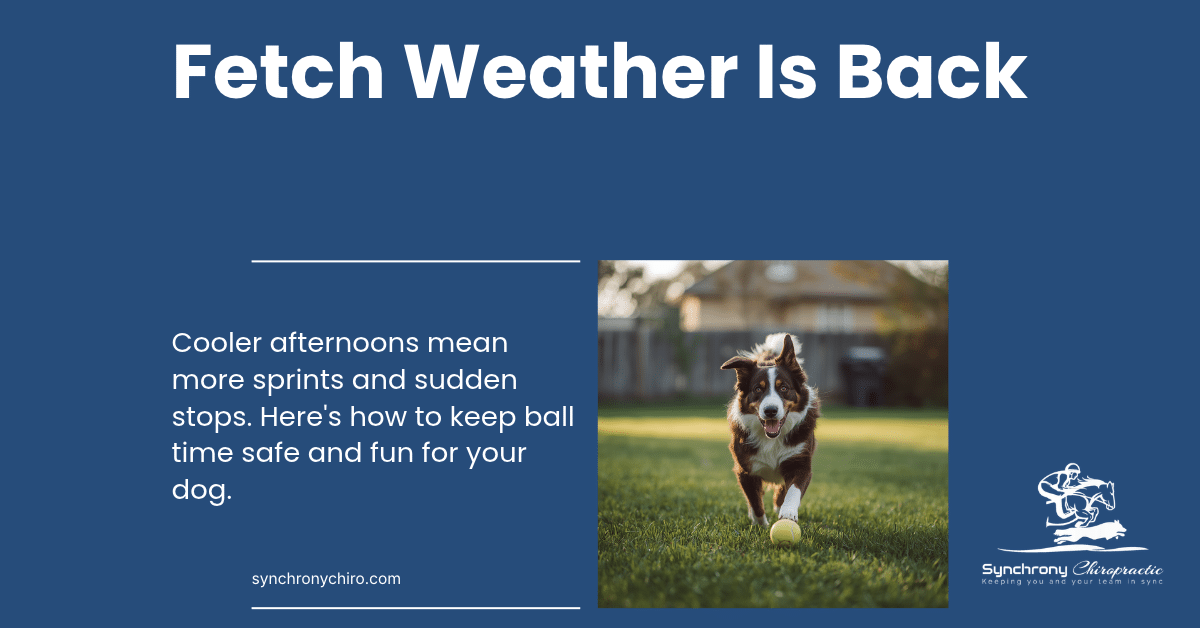

The first cool afternoon of November hits differently. You step into the yard, and before the door even closes, there’s a slobbery tennis ball at your feet.
All summer, fetch came in short bursts before the heat sent everyone inside. Now the weather is perfect, and your dog would happily play until dark.
Here’s the thing about the dog who won’t quit. They really won’t. Calling the game is your job.
Why fetch is harder on a body than it looks
Fetch looks simple. Throw, run, grab, return. But for your dog, each throw can mean a flat-out sprint, a hard stop, a quick turn, and sometimes a leap.
University veterinary guidance on playing ball points to that combination of dead running, turns, and abrupt stops as a common source of injury. Leaps and twists to catch a toy midair can lead to injuries too, both sudden ones and wear that builds from repetition.
None of that means fetch is bad. It means how you play matters.
Easing back into the season
After a summer of shorter sessions, your dog may not be in the same shape for long games. Their enthusiasm is the same. Their conditioning may not be.
Think about starting with shorter sessions for the first couple of weeks. Then build up gradually as you see how your dog handles them.
Change how you throw
A few small changes can take a lot of the strain out of fetch.
- Have your dog wait until the ball lands before they take off. That cuts down on the dead sprint and sudden stop.
- Keep throws low and along the ground, so your dog isn’t leaping and twisting to catch.
- Throw into tall grass sometimes, so your dog has to search with eyes and nose.
- Choose a toy that suits your dog’s size. A ball that’s too small can be a choking risk for a big dog.
Mixing in searching games is a bonus. The same guidance notes that mental work tires a dog out well, and it’s easier on the body than another round of sprints.
Stop before your dog is spent
This is the hardest part, especially with a high-drive dog. Many dogs will keep running long after their body would like a break.
University veterinary guidance offers a handy sign to watch for. If your dog’s tongue is getting wider at the tip or curling at the edges like a spoon, they’re getting tired.
A tired dog is more likely to get hurt. So the best time to end the game is while your dog still wants one more throw.
Watch the cool-down and the next morning
After play, watch how your dog moves around the house. Then pay attention again the next morning.
Things worth noticing:
- Stiffness getting up after a nap
- Hesitating before jumping into the car or onto the couch
- Shorter strides or a change in how they trot
- Licking at a leg or paw
- Less interest in the next game than usual
Compare what you see with your dog’s normal. One sleepy morning after a big play day is common. A pattern deserves attention.
If you notice limping, or soreness that doesn’t settle, call your veterinarian.
Fitness off the field matters too
Fetch shouldn’t be your dog’s only exercise. University veterinary guidance notes that a fit dog is less likely to be injured. Fitness includes stretches, muscle-building work, and other kinds of aerobic activity.
Keeping your dog at a healthy weight also helps. Extra pounds add stress to muscles, tendons, and ligaments every time they sprint and stop.
For dogs who compete
If your dog also does agility, flyball, or disc, fetch at home adds to their total workload. Count it.
On heavy training or competition weeks, backyard play can be a calmer game. Try searching for a ball in the grass, or a few short, low tosses.
Where we fit
High-drive dogs ask a lot of their bodies, and they rarely tell you when they’ve had enough. Chiropractic care can be one part of keeping your dog comfortable and moving well, alongside your veterinarian and smart play habits.
We come to your home, so your dog stays relaxed in familiar surroundings.
If your dog seems stiff after fetch, or just not quite themselves, we’d be glad to take a look. Text us at 352-356-8665 to book.