
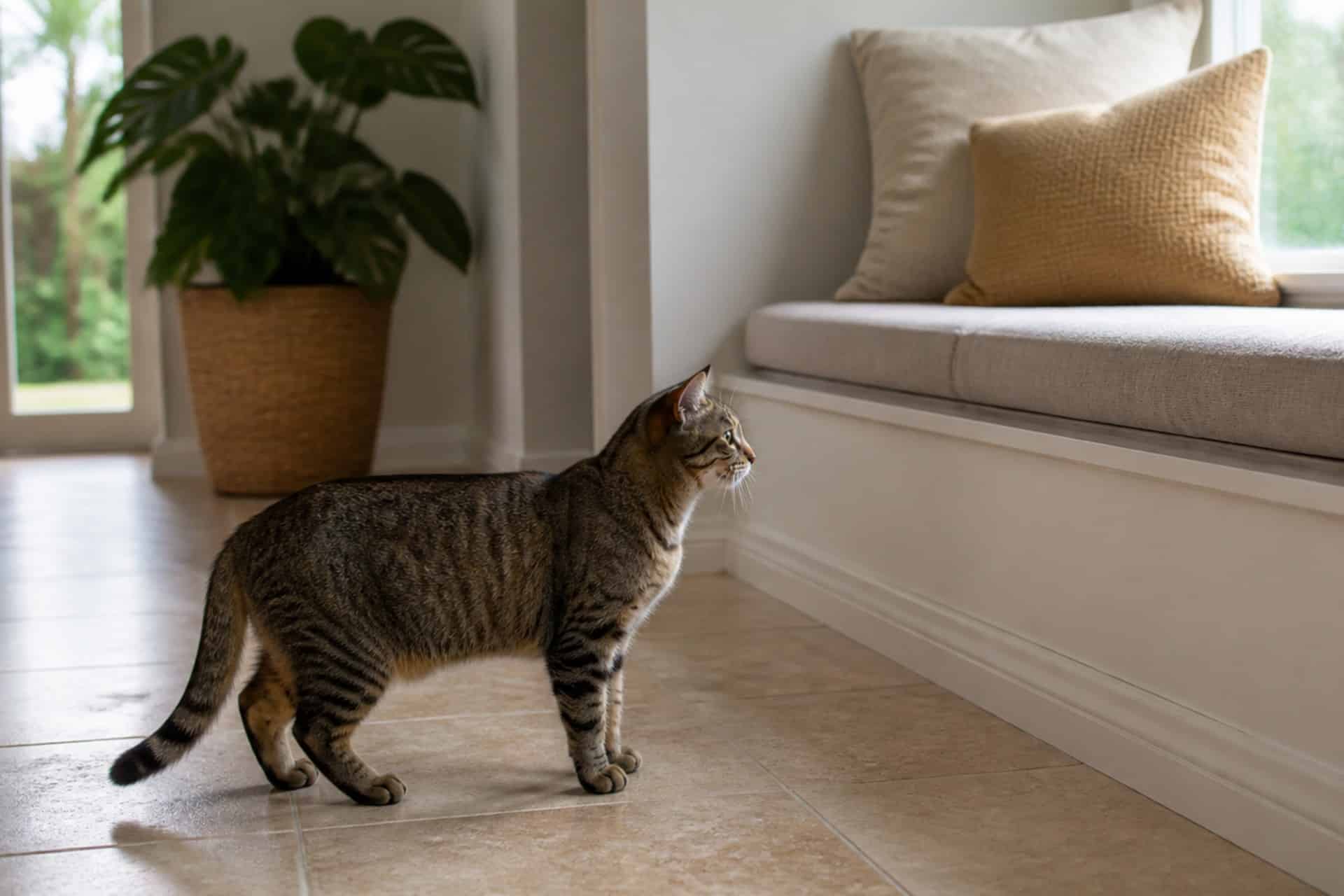

Your cat still gets to the windowsill.
She just gets there differently now.
Instead of jumping from the floor, she steps onto the ottoman first. She pauses before the counter. She pulls with her front feet instead of landing lightly, or looks up at the favorite spot and decides the tile is good enough today.
In a Florida August, that last choice is easy to explain away. The floor is cool. The afternoon is hot. The storm has darkened the window anyway.
Sometimes the cool tile really is the whole story. But when a familiar jump changes—not once, but as a pattern—it is worth watching how the rest of your cat’s day has changed with it.
Cats edit their routines quietly
Dogs may stand at the stairs and ask for help. Horses may feel different in one rein. Cats are often subtler. They solve the problem by changing the route.
The leap to the bed becomes floor-to-bench-to-bed. The high perch goes unused. The litter box with the tall side becomes less appealing. A cat who once met you on the bathroom counter begins waiting near your feet instead.
No announcement. Just an edit.
That is why owners are often the first people who can spot a meaningful change. You know the household map your cat has followed for years: where she sleeps, which chair is the launch point, how she lands, and how quickly she climbs the stairs when a treat bag opens.
Watch for changes such as:
-
pausing or rocking backward before jumping;
-
choosing a lower surface or adding an intermediate step;
-
pulling up mostly with the front legs;
-
landing heavily or with less control;
-
climbing up but hesitating to jump down;
-
using stairs more slowly or avoiding them;
-
playing on the floor instead of chasing upward;
-
grooming the back, hips, or hindquarters less thoroughly;
-
difficulty stepping into a high-sided litter box;
-
irritability when touched or lifted in a familiar way.
One sign alone does not tell you why it is happening. A group of changes gives your veterinarian a much clearer picture.
The landing can tell you as much as the takeoff
Owners naturally watch whether a cat can reach the destination. Try watching the whole movement instead.
Before the jump, does she crouch evenly? Does she load both hind legs or shift away from one side? Does she make several small calculations before committing?
During the landing, does she arrive softly and continue walking, or land stiffly and stop? Does she immediately sit down? Does she avoid jumping back from the same height?
Also compare direction and surface. A jump from carpet may feel more secure than the same jump from smooth tile. Going up asks the hindquarters to produce force; coming down asks the body to absorb it. A cat can therefore keep climbing to a favorite place while becoming much less confident about the return trip.
A ten-second phone video can help document the change for your veterinarian, provided you record a movement your cat chooses naturally. Do not repeatedly lure or test a painful-looking jump for the camera.
Do not write every change off as age—or weather
Cornell’s Feline Health Center notes that joint discomfort in cats can show up as reduced activity, stiffness, trouble getting into a litter box, avoiding stairs, and incomplete grooming. It also emphasizes that slowed-down behavior should not automatically be attributed to age. Veterinary evaluation is needed because arthritis is only one possible explanation, and other joint, neurologic, metabolic, or injury-related problems can also change movement.
Weather and routine still matter. During hot, storm-heavy weeks, an indoor cat may spend longer stretches on cool floors and less time at a sunny window. That can make a jump change easier to notice, but it does not prove that heat caused it.
Look for consistency across several days:
-
Is the same jump being avoided morning and evening?
-
Has the cat changed more than one route?
-
Are grooming, play, stairs, or litter-box habits different too?
-
Did the change appear suddenly after a fall or awkward landing?
-
Is appetite, breathing, balance, or behavior also different?
Call your veterinarian promptly for sudden or severe movement changes, inability to use a limb, dragging a limb, loss of balance, obvious pain, a significant fall, breathing difficulty, or a cat who stops eating or cannot use the litter box normally. Do not give human pain medication; many common products are dangerous for cats.
Make the home easier while you seek answers
You do not have to wait for a diagnosis to make ordinary routes less demanding.
Consider:
-
a stable stool or pet step beside the bed or favorite window;
-
a low-entry litter box in an easy-to-reach location;
-
nonslip runners between resting, feeding, and litter areas;
-
food and water placed where stairs are not required;
-
a warm, supportive resting option as well as access to a cool surface;
-
play that stays low and controlled instead of demanding repeated vertical leaps.
The goal is not to stop healthy movement. It is to give the cat choices and reduce unnecessary slips or large jumps while you learn what is driving the change.
After veterinary causes have been evaluated, chiropractic care may be worth discussing as one supportive piece of a broader plan for a cat with altered movement or joint-motion restrictions. It should not replace veterinary diagnosis, pain management, environmental changes, or treatment for an underlying condition.
Trust the route change
Cats are very good at making a difficult movement look like a new preference.
That does not mean every afternoon on the tile is a warning sign. It means the route matters. The extra stool, the pause before takeoff, the heavy landing, and the suddenly abandoned perch are useful details when they repeat.
You do not need to diagnose what you are seeing. You only need to notice it clearly.
If your veterinarian has addressed medical concerns and your cat continues to move differently, contact Synchrony Chiropractic to ask whether a feline chiropractic evaluation may fit into the care plan. Synchrony accepts cats and provides mobile care across Gainesville, Ocala, The Villages, and the communities in between.