
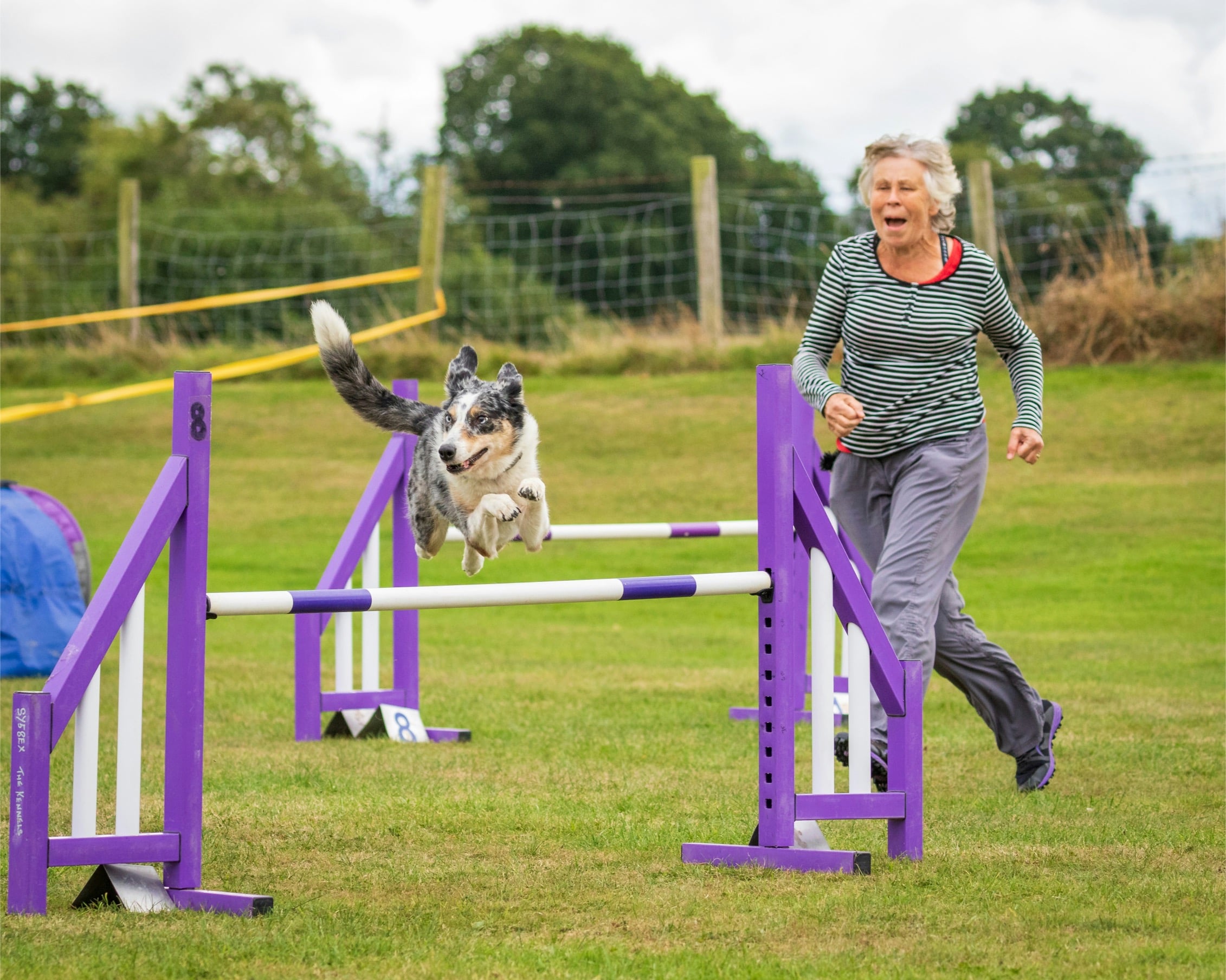

You’ve watched the video back three times.
The weave entry was perfect. The approach to the jump was on line. And then, right there, frame by frame, she dropped the bar. Again. Same jump. Same side. Third trial in a row.
You’ve adjusted your handling. You’ve drilled the approach. You’ve changed your footwork, your timing, your position.
And she keeps dropping that bar.
Something the agility world does not talk about enough: some performance problems are not training problems. They are body problems. And no amount of repetition or handling adjustment is going to fix a body that is working around something it cannot tell you about.
Florida has one of the most active agility communities in the country. The year-round trial season, the heat, the demanding surfaces, the sheer volume of training hours these dogs put in, it all adds up. And the dogs who stay sound, consistent, and competitive over the long haul are usually the ones whose handlers figured out that a clean run starts long before the opening buzzer.
It starts with a clean spine.
What Agility Actually Demands From a Dog’s Body
Before we talk about chiropractic care, it is worth taking a moment to appreciate what we are actually asking agility dogs to do.
An agility run is a full-body athletic event. In the span of 30 to 60 seconds, a dog is asked to:
- Accelerate and decelerate repeatedly at high speed
- Collect and extend stride on cue
- Execute tight turns in both directions
- Navigate weave poles requiring rapid lateral spinal flexion
- Launch, arc, and land over jumps at varying heights
- Maintain body awareness and responsiveness throughout
Every single one of those demands requires the spine and nervous system to be communicating clearly and efficiently.
When they are, the dog is fluid, responsive, and fast. When they are not, the dog compensates. And compensation in an agility dog looks a lot like a training problem.
The Florida factor is real, too. Heat, humidity, and a calendar packed with trials mean Florida agility dogs are often working harder and recovering less than dogs in cooler climates with slower competitive seasons. That combination makes proactive body care not just helpful, but genuinely necessary.
The Spine as the Control Center for Performance
Here is the foundational principle behind everything we do:
The spine is not just structural. It is neurological.
Every nerve signal that travels between your dog’s brain and her body passes through the spinal cord and exits through the spaces between vertebrae. When those joints are moving well, communication is fast and clear. The muscles activate on time. Proprioception (the body’s sense of where it is in space) is sharp. The dog moves with precision.
When a joint loses its normal range of motion, that communication gets disrupted. The nervous system starts working around the restriction. Muscles fire at the wrong time or in the wrong sequence. The dog begins compensating in ways she is not even aware of.
In an agility dog, that compensation might look like:
- Knocking bars on a specific side (protecting a shoulder, hip, or thoracic restriction)
- Popping weave poles (reduced lateral spinal mobility makes full weave flexion uncomfortable)
- Adding a stride before a jump (adjusting takeoff point to avoid loading a sore area)
- Tight or wide turns in one direction (asymmetry in the spine or pelvis affecting bend and collection)
- Reluctance to drive to the table (spinal or hip discomfort making the drop position painful)
- General flatness or lack of drive (a body working hard just to move normally has less left for performance)
None of these are attitude problems. None of them are solely training problems. They are the dog’s body communicating as clearly as it knows how.
What We Look For in an Agility Dog Assessment
When an agility dog comes to see us, we are not just checking for obvious pain. We are assessing the entire movement picture.
Observation before touch. We watch the dog move before we ever lay a hand on them. Gait, posture at rest, how they carry their head and tail, whether their hind end tracks straight behind their front end. These observations often tell us exactly where to look before the hands-on assessment even begins.
Static palpation. We move along the spine systematically, feeling for areas of restriction, asymmetry, or tension. Agility dogs often have very specific patterns. We commonly see:
- Cervical (neck) restriction from tight weave work and repetitive head turning
- Thoracic (mid-back) restriction from jump impact and collection demands
- Lumbar restriction from turns, weave poles, and the cumulative load of a full season
- Sacroiliac tension from the explosive power demands placed on the hind end
- Shoulder and hip restriction from asymmetrical landing or compensation patterns
Motion palpation. We test the actual range of motion in each joint, confirming what the static assessment suggested and identifying where the nervous system is most affected.
Handler conversation. We always want to hear what you are seeing on course. Where is the breakdown happening? Is it consistent? Does it favor one direction? Has it changed over the season? You spend more time with your dog than anyone. That information is invaluable.
The Adjustment and What Happens After
An adjustment for an agility dog is precise, targeted, and relatively quick. It is not a dramatic event. Most dogs tolerate it easily, and many seem visibly relieved during or immediately after.
The adjustment restores normal motion to a restricted joint. When that happens, a few things follow:
- Muscles release. The tension that was guarding the restricted area no longer has a reason to be there.
- Nerve communication improves. Signals travel more clearly between the brain and the body.
- Proprioception sharpens. The dog’s sense of where her body is in space becomes more accurate.
- Compensation patterns begin to unwind. This takes a little time, but the body starts finding its way back to natural, efficient movement.
What handlers typically notice in the days following an adjustment:
- A looseness and ease in movement that was not there before
- More enthusiasm and drive going into work
- Improved symmetry in turns and collection
- Cleaner weave entries and exits
- Better focus and responsiveness overall
One of our favorite things to hear from a handler is: “I don’t know what you did, but she felt completely different at practice.”
That is not coincidence. That is a nervous system running without interference.
Insider Tips from Dr. Philip and Dr. Angela
On timing care around the trial calendar: We recommend scheduling a chiropractic visit in the week before a major trial, not the day before. The body needs a little time to integrate an adjustment and settle into the new motion pattern. Day-of or day-before adjustments can sometimes leave a dog feeling a little loose or different than usual. A few days of normal training after an adjustment tends to produce the best trial performance.
On the dogs who benefit most: Every agility dog benefits from regular chiropractic support, but the ones who respond most dramatically are the ones who have been compensating quietly for a while. If your dog has been “almost right” for a season and you cannot figure out why, that is often a body issue, not a training issue.
On frequency for active competitors: For dogs in regular competition, we generally recommend a maintenance visit every four to six weeks during the active trial season. Off-season is a great time for a full assessment and addressing anything that built up during the year.
Why Florida Handlers Specifically Need to Pay Attention
Florida is an incredible place to compete in agility. The community is strong, the events are plentiful, and the year-round climate means dogs can train and trial without the seasonal breaks that handlers in colder states deal with.
But that same advantage creates a specific risk.
Year-round competition means year-round accumulation. Dogs in Florida do not get a natural off-season where the body gets a chance to rest and reset. They are going hard from January through December. Restrictions that might resolve on their own with a month of lighter work in a northern climate can quietly compound into something more significant over a Florida season.
The heat adds to the load. Working in Florida heat requires more effort from the cardiovascular and muscular systems. Dogs are working harder physiologically even on moderate training days. A body that is already compensating around a restriction has even less reserve to draw on.
Trial surfaces vary. From grass to turf to dirt to rubber mats, Florida dogs encounter a wide range of footing throughout the year. Each surface loads the body differently, and inconsistent loading patterns can contribute to restriction development over time.
We are not saying this to scare you. We are saying it because Florida handlers who build proactive chiropractic care into their dogs’ routines tend to have dogs who stay sound longer, compete more consistently, and recover faster when something does crop up.
What a Chiropractic-Forward Care Routine Looks Like
Building chiropractic into your dog’s routine does not have to be complicated. Here is a simple framework that works well for most active agility competitors:
| Timing | Purpose |
| Start of season baseline assessment | Identify and address anything that accumulated in the off-season |
| Every 4-6 weeks during active competition | Maintain optimal spinal motion and nervous system function |
| After a fall, collision, or unusual incident | Rule out new restriction before it becomes a compensation pattern |
| Pre-major trial (5-7 days before) | Fine-tune and ensure the body is moving at its best |
| End of season | Full assessment and reset before the off-season begins |
This is not about over-treating. It is about staying ahead of the problem instead of chasing it.
The Dogs Who Do Not Look Like They Need It
We want to address something directly, because we hear this often: “My dog seems fine. She is not in pain. She is still running fast.”
Here is the honest truth. A dog can be running fast and still be compensating. Speed is not the same as efficiency. A dog who is protecting a restriction will find a way to keep performing, often right up until the moment the body cannot compensate any further.
The dogs who impress us most are not the ones who come in already struggling. They are the ones whose handlers bring them in proactively and discover a restriction that has been quietly limiting performance in ways nobody had named yet.
“I didn’t realize she had been bracing through that shoulder until it wasn’t there anymore” is something we hear regularly.
You do not have to wait for a problem to be obvious before you address it. In fact, the best time to address it is before it ever becomes obvious at all.
The Bottom Line for Florida Agility Handlers
Your dog is an athlete. A serious, talented, hardworking athlete who gives everything she has every single time she steps to the line.
She deserves the same level of physical support that any serious athlete receives.
Chiropractic care is not a last resort. It is not just for dogs who are hurting. It is a performance tool, a recovery tool, and a longevity tool all at once. And for Florida handlers running dogs in a year-round competitive environment, it is one of the most practical investments you can make in your partnership.
Clean runs start with a clean spine.
If you are in Florida and You’ve been wondering whether chiropractic care could help your agility dog, we would love to take a look. Reach out to Synchrony Chiropractic and let us be part of your team.